


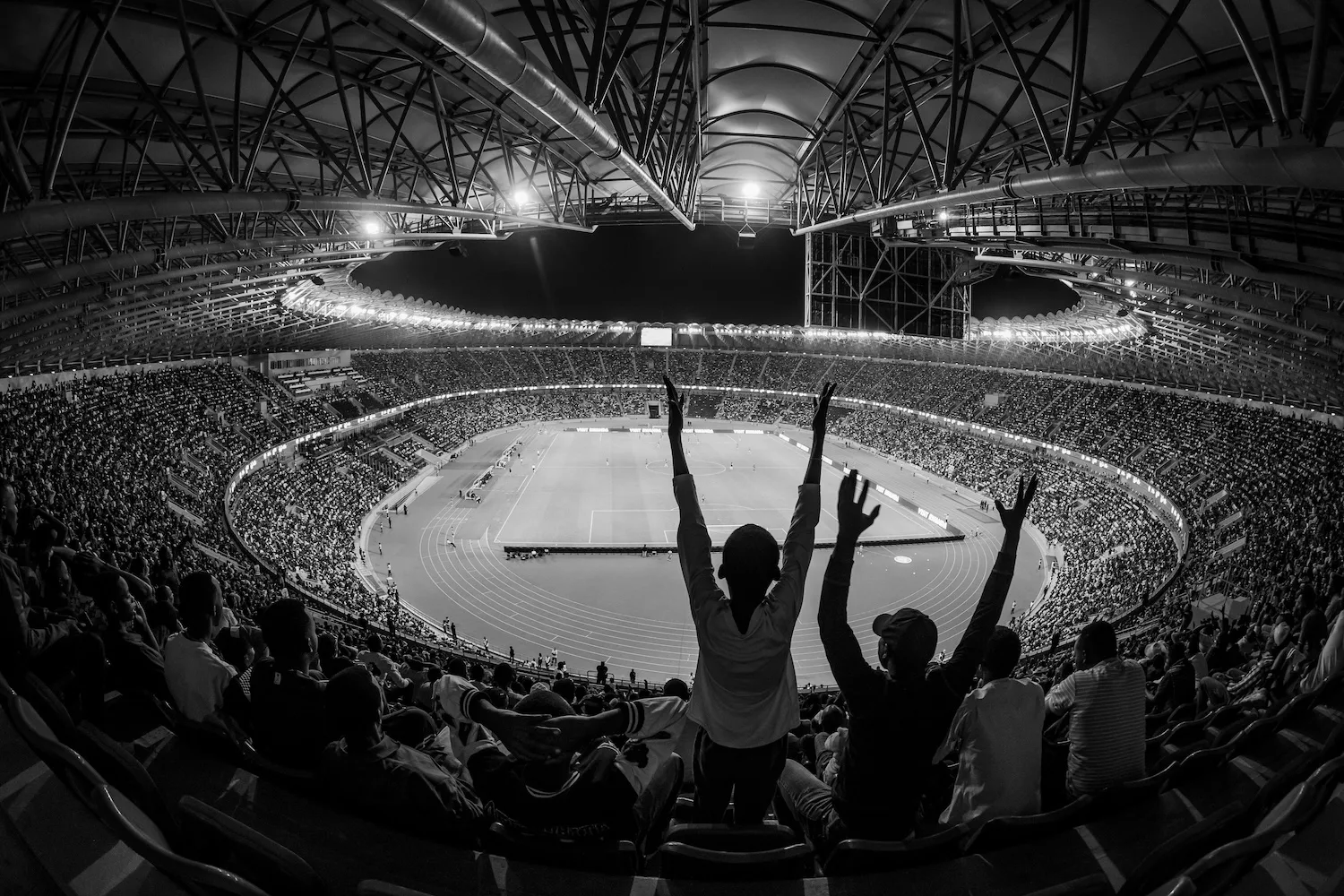
Every sports fan knows that sudden rush of adrenaline—the “butterflies” in the stomach when witnessing a legendary performance, an epic final, or an improbable comeback. It’s a visceral sensation that makes us want to be right there: on the pitch, behind the wheel, or carving down the slopes.
But behind these near-magical images lies a different kind of performance. While the world watches the athlete, the sport videographer, camera operators, and drone pilots are engaged in a paradoxically discreet yet breathtaking feat of technical skill. The challenge is immense: how do you capture the invisible? How do you translate raw effort into a visual narrative while maintaining perfect stability and clarity? Let’s dive into the craft behind the lens.
Field Fundamentals: Capturing Effort Across Terrains

Conveying emotion starts with a physical understanding of the sport. Every discipline requires a specific visual grammar to bridge the gap between the athlete and the viewer.
- On the Field (Stadiums & Arenas): Here, emotion is found in the human detail. The secret lies in the art of the tight crop to isolate the player from the roar of the crowd. By using a shallow depth of field, we capture the gaze, the sweat, and the tension. Precision in “follow-focus” is essential to ensure the emotional connection is never broken.
- On the Track (Motorsports): The goal is to translate pure speed without sacrificing clarity. By using a mix of fixed “curva” cameras and tracking vehicles, we recreate the violence of G-forces and the precision of the racing line, keeping the footage fluid enough for the viewer to follow the tactical battle.
- Extreme Outdoors (Mountains & Olympic Games): In the vastness of the peaks, a sport videographer must battle harsh light, snow glare, and unpredictable weather. Agility is paramount; the gear must be light and the operator mobile to capture the vulnerability of the athlete against the scale of the environment.
The Drone Revolution: From Observation to Total Immersion
The arrival of drones has redefined sports broadcasting standards. The camera no longer simply watches the athlete; it becomes an athlete itself.
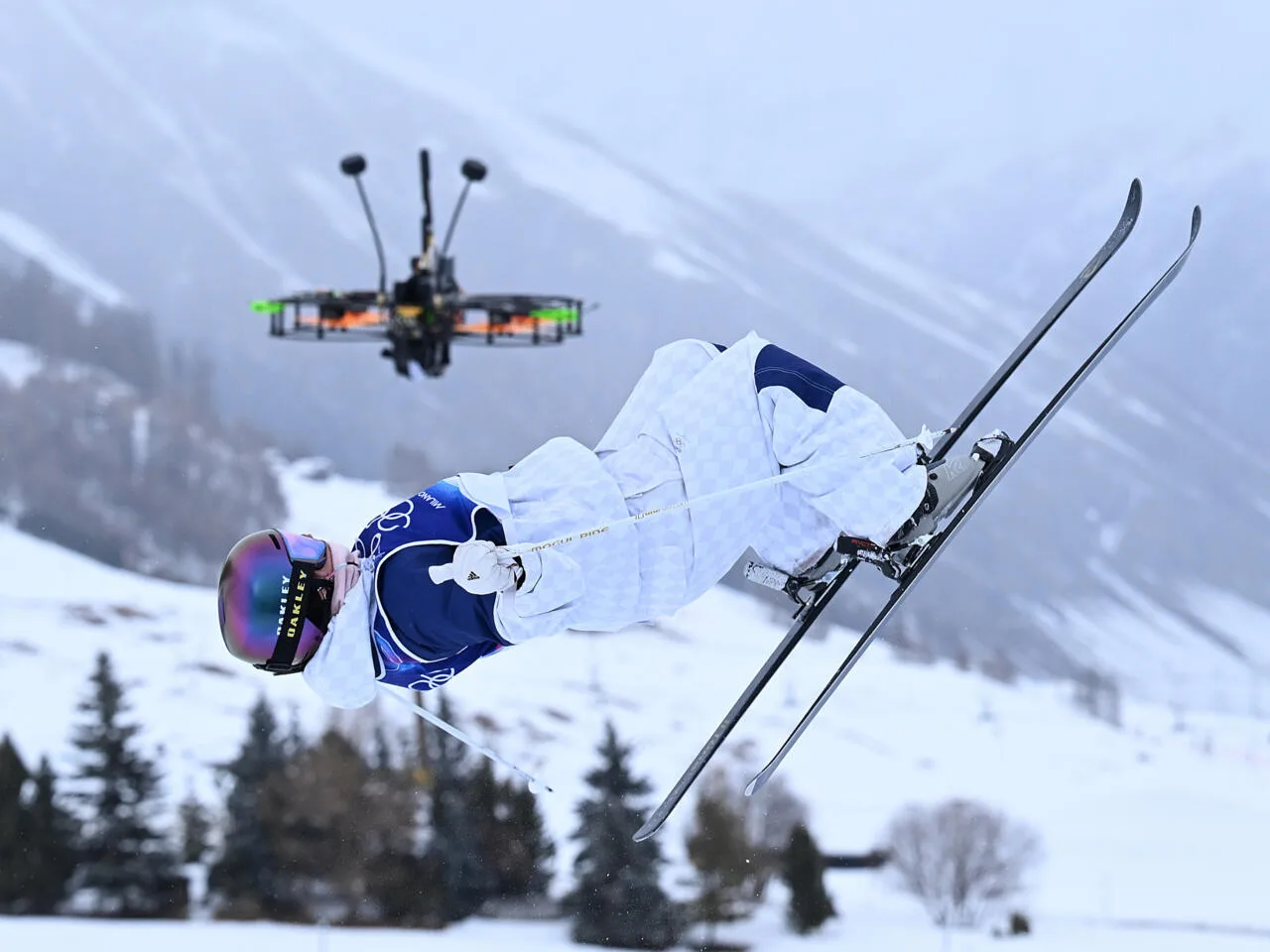
FPV vs. Cinematic Drones
Two complementary approaches now dominate the industry:
- FPV (First Person View) Drones: Reaching speeds over 100 km/h, these drones “stick” to the skier or dive into a corner with a racing car. This is the ultimate tool for raw, visceral immersion.
- Cinematic Drone: Essential for storytelling, they provide sweeping, stabilized bird’s-eye views that allow the spectator to grasp the scale and stakes of the event.

High-Level Technical Standards
Following the rigorous standards set by pioneers like France Télévisions, drone piloting in sports has become a choreographed discipline. It’s no longer about flight; it’s about precision movement.
Furthermore, by utilizing high frames per second (fps), we use Super Slow Motion to deconstruct a technical gesture, turning a split-second movement into an eternal, emotional moment.
The Invisible Challenge: Mastering the "Media-Mass"
For the magic to work on screen, a complex infrastructure must manage data behind the scenes. This is the “engine room” of the passion.
- Real-Time Workflow: Delivering 4K or 8K feeds from a drone or an isolated camera to the gallery with zero latency is a technical triumph. Without this immediacy, the “live” emotion is lost.
- Video Organization: On major events, videographers generate terabytes of footage. Utilizing intelligent cataloging tools like Peakto is a game-changer. Being able to instantly locate “the” perfect shot among thousands of files allows editors to create high-impact highlights or social media reels in minutes.
- The Politeness of Stability: Immersion must never come at the cost of comfort. Stabilization—whether mechanical or software-based—is the boundary between footage that causes vertigo and footage that causes goosebumps. It ensures the clarity needed for the audience to stay focused on the performance.
Sports Video Is More Than Footage It’s a Legacy
Beyond pixels, sensors, and stabilization algorithms, the role of a sport videographer is to be a “conveyor of emotion.” We are the privileged witnesses to the extraordinary.
Filming sports means disappearing behind the action to better sublimate it. It is the knowledge that a perfect camera angle or a daring drone trajectory might inspire a child on the other side of the world to push their own limits. Our mission is to immortalize the fleeting—to turn a few seconds of effort into an inspiration that lasts for years. Athletes write history; videographers give it eternity.
FAQ - Emotion in Sports Video
What is the best frame rate for sport videography?
Should I use an FPV drone or a standard cinematic drone?
It depends on the “feeling” you want to convey. Use a standard cinematic drone (like a DJI Mavic) for establishing shots, tracking slow-moving subjects, and providing a stable, wide perspective of the venue. Choose an FPV drone when you want to create a “rollercoaster” effect, following an athlete at high speeds or diving through narrow gaps for maximum adrenaline.
How do I avoid "shaky" footage during high-action sports?
Stability is what makes sports footage look truly professional—especially with fast action and long lenses. You typically get the best results by combining:
- Hardware (on set): a 3-axis gimbal for handheld work, a monopod/tripod with fluid head for sidelines, and a shoulder rig when you need mobility without micro-jitters.
- In-camera (capture): optical stabilization (OIS/IBIS) when available, plus electronic stabilization (EIS) (e.g., RockSteady / HyperSmooth) for action cams and drones—useful, but it can crop the image.
- Software (post): gyro-based stabilization (when your camera/drone records gyro data) or standard stabilizers in editing apps to polish the shot while keeping framing natural.
Rule of thumb: prioritize stable capture first (support + technique), then use EIS/gyro/post to fine-tune—this keeps motion looking intentional rather than “floaty” or overly cropped.