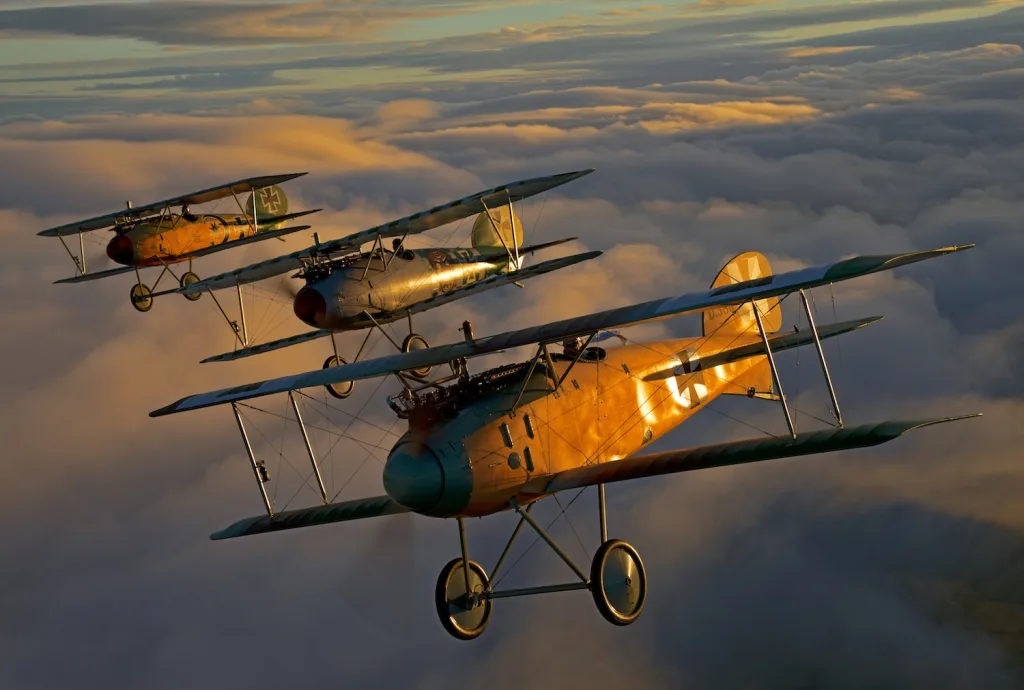



For Philip Makanna, aviation photography has never been just about airplanes. It has always been about memory, wonder, and the dreams that first took shape in childhood.
For more than five decades, his GHOSTS photographs have brought historic aircraft back to life — not simply as machines, but as symbols of another time. Today, with an archive of more than 200,000 images, Makanna is thinking as much about preservation as creation: how to keep a lifetime of photographs accessible, meaningful, and alive for future generations.
In this interview, he looks back on the flights, images, and stories that shaped his work — and on the legacy he hopes to leave behind: “I hope that someone will be able to dream my dreams.”

The Beginning
You made your first aviation photograph in 1974. Do you remember that photograph — and what made you point your camera at an aircraft in the first place?
I had gone to the Reno Air Races, assigned to photograph a team of parachute jumpers. There was a flight of WWII aircraft from the Confederate Air Force at Reno that year. I was born in 1940 and had grown up with these airplanes. I knew them from my dreams.

Was there a moment when you realized aviation photography was going to become much more than a hobby for you?
I went to New York, hoping to find a publisher for a book of my circus photographs. New York liked my circus work but the little collection of airplane photographs that I had in my case was what New York bought. The publisher sent me to Texas in 1976 where I wrote and photographed my first book: “GHOSTS, A Time Remembered” (1978). In 1980 my wife and I published the first “GHOSTS” calendar. We have published the “GHOSTS” calendar for 47 years. There have been 13 GHOSTS books.

More than 50 years later, what still excites you when you see one of these aircraft take to the sky?
Flying is a dream that we all have. Flying brings a special perspective … to see the world from above … to see the patterns that we make … to move with freedom like a bird. There is nothing more magical than leaving the ground and moving through the clouds – and then to meet another airplane in the sky and to fly wingtip to wingtip together. Flying is a secret world of wonder and beauty and grace.

Photographing the GHOSTS
You chose the name GHOSTS for your work. What does that word represent to you?
GHOSTS is a reference to mysteries of the past. My work has always been focused on history and memories.
“GHOSTS, A Time Remembered” – I have the shadowed memory of a great rumbling sound. The screen door is banging and my mother is running across the lawn. “Planes! …”
Shading her eyes, searching the sky, she is lost in the thunder that rolls over us. She points and I see tiny shadows in the clouds. Planes are being moved to a place beyond my imagination.

Your photographs don't simply document aircraft — they often make them feel alive. What are you trying to capture beyond the machine itself?
I am trying to photograph the dreams that I had when I was a little boy.
I was a child of a war. I believed, as did most of the other little boys of my generation, that the planes were magic; we dreamed and listened to stories about them with wonder. I remember hearing that at dawn on D-day, the sky was filled from horizon to horizon with black and white stripes that were painted on the wings of every plane. They were the simple, secret marking that darkened the sky over the channel that day. We didn’t see them, but we dreamed.

Historic aircraft are spectacular subjects, but they must also be incredibly challenging to photograph. What makes a truly great aviation photograph for you? Do you have any specific gear to recommend for aviation photography ?

After photographing aviation for more than five decades, is there one flight, aircraft or photograph that still stands out in your memory?
One flight? – They were all unforgettable.
One flight? – I had flown with the great Lefty Gardner and his P-38 for many years. After Lefty’s death his P-38 was restored and I flew with it again over a lake in Texas. My pilot that morning was Lefty’s son.


A Lifetime of Images
Photography has changed dramatically since you started in the 1970s. What has the transition from film to digital changed most in the way you work?

You now have more than 200,000 photographs in your collection. When you look at that archive today, do you see a photographic library, a personal history, a historical record — or perhaps all three?
I have documented hundreds of types of aircraft. My work begins with original Bleriot aircraft from 1911. I have photographed many of the aircraft of World War One. I have flown in original airplanes that are over 100 years old. I have photographed and flown in hundreds of World War Two aircraft.
I have photographed history.
I have secured all of my aviation work and some of my personal work but I worry about its future. Will anyone care about what I’ve done after I’m gone? Will anyone be able to find my work?

Has the way you organize and revisit your photographs changed as the collection has grown? What is your workflow working and dealing with your archives?
All of my 50 years of work is managed digitally. My files are grouped in categories that inter-relate. My aviation work is listed by aircraft types and by the places where they were photographed. My personal work is listed in categories: People – Landscape – Films – “Art” …
All of my work is immediately available and easily moved from my computer to the world. This is hugely important.
Do you think photographers sufficiently consider the long-term preservation of their digital work when choosing the software they use today? Why is it important?
In these past 20 years, I have organized and maintained my film and my digital work with a brilliant management system – Media Pro. But, as far as I know, Media Pro is not supported today. I am struggling to rebuild my archive in a mainstream system. This is not an easy task.
If my archive cannot be easily accessed by future generations it will vanish.

Beyond changing software, did moving the collection give you a different perspective on your archive or make you want to revisit parts of your work?
My system moves quickly and is very flexible. It has allowed me to wander through my life. It has discovered the details and the secret stories that I have forgotten. I continue to work with my aviation photographs but I am currently making little books of my other images. I have titled each of these books “FORTY FOUR PHOTOGRAPHS”. I have recently finished BOOK TEN. Each of these books is a visual narrative … a personal poem.


Photography, Memory and Legacy
The aircraft you photograph are themselves pieces of history. Has preserving your photographs become increasingly important to you as another way of preserving that history?
Yes. I am an old thing now. Preserving my work has become the most important part of my life. I don’t fly any more. I spend my days wandering through my past … editing … trying to make sense of the good stuff … trashing the bad stuff. I am trying to shape what I have done to make it understandable and available.

When someone discovers your GHOSTS photographs 20 or 30 years from now, what would you like them to feel or understand?
And finally, what advice would you give to a young photographer who wants to dedicate years — perhaps even a lifetime — to photographing one subject they deeply care about?
Study the work of Jacques Henri Lartigue. Study and enjoy… Study the work of Henri Cartier-Bresson. Study and enjoy… I wish that every young photographer will be as lucky as I have been.

To see more of Philip Makanna’s aviation photography, you can follow him on his website.
Photo credit: © Philip Makanna/GHOSTS